If a spec sheet, a test plan or a customer asks you for GB 34660-2017, you are in the right place. It is China's mandatory electromagnetic compatibility (EMC) standard for road vehicles, and it is still the edition in force today.
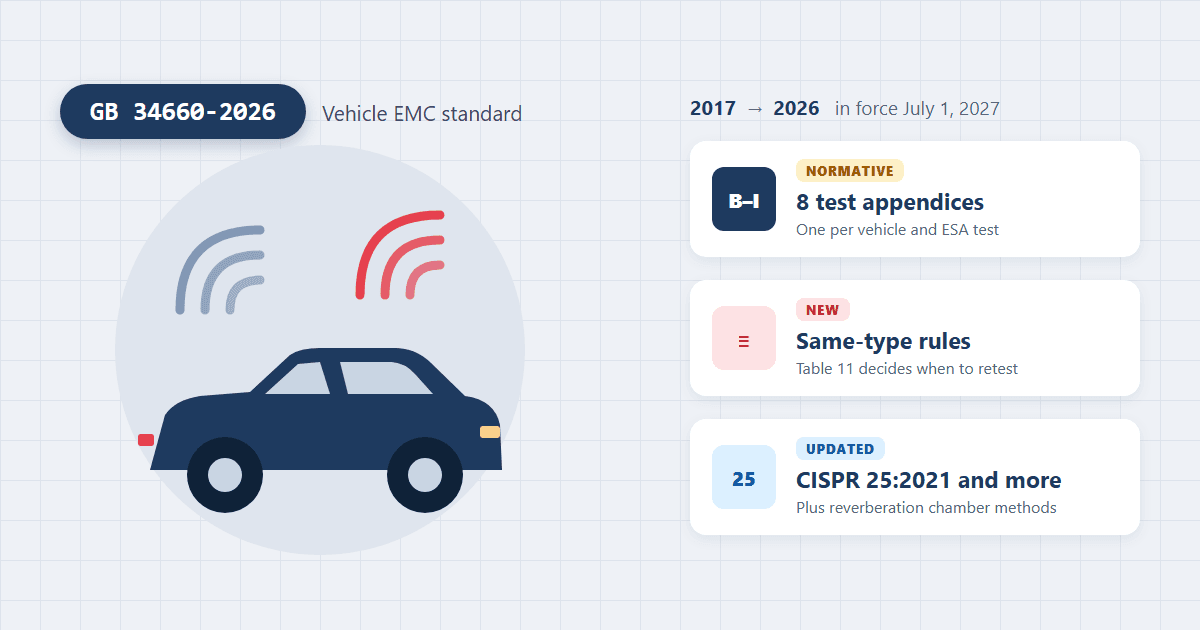
But a new edition is coming. GB 34660-2026 was published on February 27, 2026 and applies from July 1, 2027. This article explains which edition you need, what the two texts share, and what changes in 2026 — based on the two documents themselves.
In short
- What it is
- China's mandatory EMC standard for road vehicles and their electronic sub-assemblies
- Chinese title
- 道路车辆 电磁兼容性要求和试验方法
- Applies to
- Vehicles of categories M, N and L, and their electrical/electronic sub-assemblies (ESAs)
- In force today
- GB 34660-2017, since January 1, 2018
- New edition
- GB 34660-2026, published February 27, 2026 by SAMR and SAC
- Switch-over
- July 1, 2027 — GB 34660-2026 replaces GB 34660-2017
- Length
- 22 pages (2017) → 50 pages (2026)
Which edition do you need?
| Your situation | Edition to work with |
|---|---|
| Testing or certifying a vehicle before July 1, 2027 | GB 34660-2017 |
| A new vehicle type that will be approved on or after July 1, 2027 | GB 34660-2026 |
| A model already in production that will still be sold after July 1, 2027 | GB 34660-2026 — check clause 8 for the transition rules |
| Planning test programmes, lab capacity or supplier specifications now | Both: 2017 for today, 2026 for what comes next |
Clause 8 of the 2026 edition, "Implementation of the standard", sets out the exact transition. Read it before you fix dates in a project plan.
What GB 34660 covers
Both editions work at two levels: the whole vehicle, and each electrical/electronic sub-assembly (ESA) — control units, sensors, motors and other electronic modules. Each level has its own tests:
| Level | Test | What it checks |
|---|---|---|
| Vehicle | Broadband radiated emission | Electrical noise the vehicle sends out over a wide frequency range |
| Vehicle | Narrowband radiated emission | Noise at specific frequencies, typically from electronics |
| Vehicle | Radiated immunity | The vehicle keeps working when exposed to strong radio fields |
| ESA | Broadband and narrowband radiated emission | The same, for each module on its own |
| ESA | Radiated immunity | The same, for each module on its own |
| ESA | Transient conducted immunity along supply lines | The module survives voltage spikes on its power supply |
| ESA | Transient conducted emission | The module does not send spikes back into the supply |
For reference, the 2017 edition limits vehicle broadband radiated emissions (quasi-peak) to 32 to 43 dBµV/m over 30–1,000 MHz with the 10 m method, and 42 to 53 dBµV/m with the 3 m method. Narrowband limits are 10 dB lower. Vehicles must withstand a field of 30 V/m over more than 90% of the 20–2,000 MHz band, and at least 25 V/m elsewhere.
The 2026 edition keeps limit tables for the same tests — Tables 1 and 2, for example, give the vehicle broadband limits at 10 m and 3 m. Do not carry the 2017 figures over to a 2026 test plan without checking the new tables.
GB 34660-2017 vs GB 34660-2026 at a glance
| GB 34660-2017 | GB 34660-2026 | |
|---|---|---|
| Published | November 1, 2017 | February 27, 2026 |
| In force | January 1, 2018 | July 1, 2027 |
| Issued by | AQSIQ and SAC | SAMR and SAC |
| Length | 22 pages | 50 pages |
| Vehicles covered | M, N and L (category O may refer to it) | M, N and L |
| Test methods | In the main text, plus 2 informative annexes | 8 normative appendices, one per test |
| Which ESAs must be tested | Informative annex | Normative Appendix A |
| Approval rules | "Type inspection" | "Determination of the same type", with a configuration table |
| Reverberation chamber methods | Not referenced | Referenced for vehicle and component tests |
What changes in GB 34660-2026
1. Every test gets its own appendix
In 2017 the test methods sat inside the main text, with two informative annexes. The 2026 edition moves each test into its own normative appendix:
- Appendix B — vehicle broadband radiated emission
- Appendix C — vehicle narrowband radiated emission
- Appendix D — vehicle radiated immunity
- Appendix E — ESA broadband radiated emission
- Appendix F — ESA narrowband radiated emission
- Appendix G — ESA radiated immunity
- Appendix H — ESA transient conducted immunity along supply lines
- Appendix I — ESA transient conducted emission
"Normative" means the appendix is part of the requirement, not guidance. Test plans and lab procedures written for the 2017 text should be updated to point to the new appendices.
2. Clear rules on which modules must be tested
The method that decides whether an ESA falls under the standard was an informative annex in 2017. In 2026 it becomes normative (Appendix A). Clause 4.1.1 is direct: an ESA submitted for type inspection that meets the Appendix A criteria must meet the ESA requirements of clauses 4.5 to 4.9 — emissions, immunity and transients.
Where the standard does not spell out the test conditions — operating state, monitored functions, failure criteria — the vehicle manufacturer and the test organisation still agree a test plan before testing (clause 4.1.2).
3. New "same type" rules for approval
Clause 6 of the 2026 edition decides when two vehicles count as the same type for EMC, and when a new test is needed:
- Vehicle tests follow a configuration table (Table 11).
- With several configurations, full coverage at component or system level is allowed: once every relevant component or system has been verified at vehicle level, combined testing is no longer required.
- If any component or system listed in Table 11 changes, the vehicle must be tested again.
- Vehicles built on a Category II chassis may be approved on the basis of the chassis tests.
- Category II chassis and single-unit vehicles with a kerb mass above 30 t do not need the vehicle radiated immunity test.
- For Category II chassis and vehicles with four or more axles, the radiated immunity test of the anti-lock braking system is not required.
4. Updated reference standards
The documents the standard relies on have been brought up to date. Your test lab needs the editions on the right:
| Topic | 2017 cites | 2026 cites |
|---|---|---|
| Antennas and test sites | GB/T 6113.104-2008 | GB/T 6113.104-2021 |
| Transients along supply lines | GB/T 21437.2-2008 | GB/T 21437.2-2021 |
| Component tests: absorber-lined shielded enclosure | GB/T 33014.2-2016 | GB/T 33014.2-2025 |
| Component tests: harness excitation | GB/T 33014.4-2016 | GB/T 33014.4-2025 |
| Component tests: reverberation chamber | — | GB/T 33014.11-2023 |
| Vehicle tests: off-vehicle radiation sources | GB/T 33012.2-2016 | GB/T 33012.2-2016 and ISO 11451-2:2025 |
| Vehicle tests: reverberation chamber | — | ISO 11451-5:2023 |
| Protection of on-board receivers | GB/T 18655-2010 (China's adoption of CISPR 25) | CISPR 25:2021 |
| Vehicle radio disturbance | CISPR 12:2005 | CISPR 12:2005 |
What stays the same
- It is still mandatory: the code starts with GB, not GB/T.
- It still covers M, N and L vehicles and their electronic sub-assemblies.
- The same families of tests, at vehicle and ESA level.
- Vehicle broadband emission is still measured with a 10 m or a 3 m method.
- Conformity of production is still part of the standard.
Who needs to act
- Vehicle makers and importers — every vehicle type sold in China is tested against it
- Component suppliers — Appendix A decides whether your module needs its own tests
- EMC test laboratories — new appendices, reverberation chamber methods, updated references
- Homologation teams — the "same type" table decides when a change means a new test
What to do now
- Keep testing to GB 34660-2017 for anything approved before July 1, 2027.
- List the vehicle types that will be approved after July 1, 2027: they follow the 2026 text.
- Run your ESAs through Appendix A of the 2026 edition to see which need component tests.
- Map your configurations against Table 11, so you know which changes will trigger a new test.
- Ask your lab whether it is ready for the new appendices and the updated reference standards.
- Read clause 8 for the rules that apply to models already in production.
Both editions are published in Chinese only. For test plans and type approval, your engineers need the exact clauses, tables and appendices.
Get the full English version of GB 34660-2026 — 50 pages with all nine appendices, invoice included. Still working to the current edition? GB 34660-2017 in English. For the other 2026 vehicle rules, see our article on GB 7258-2026.