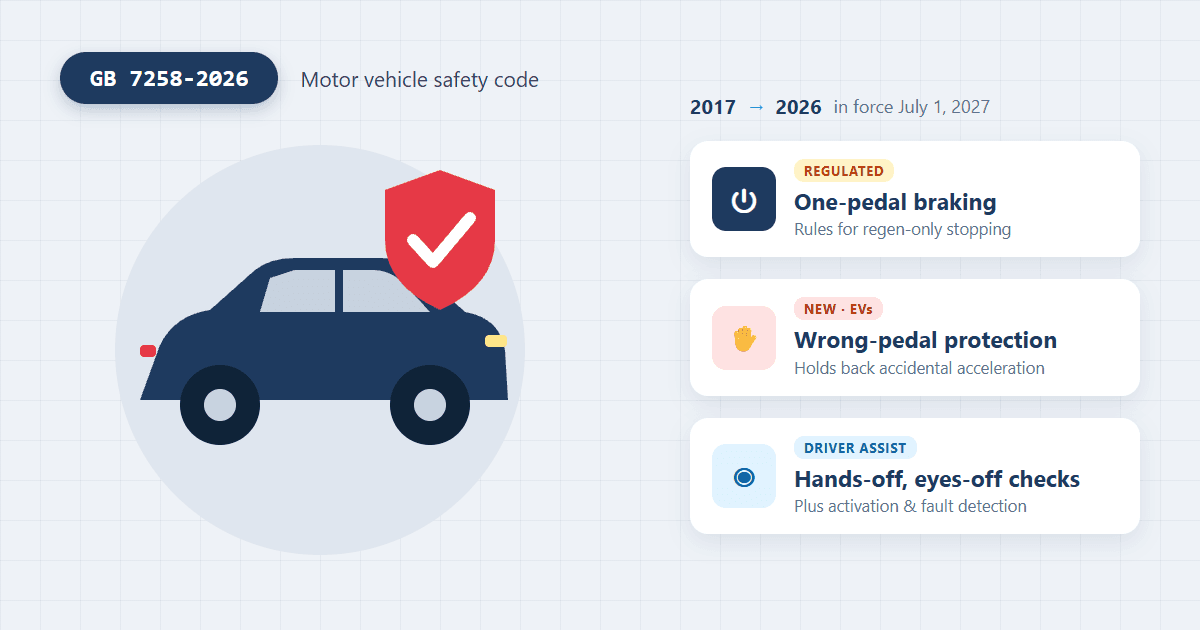
China has many vehicle standards. GB 7258 is the one that holds them all together. It is the safety rulebook a vehicle is checked against when it gets type approval, when it is registered, at every periodic inspection, and at the roadside.
In August 2026 China published a new edition, GB 7258-2026. It applies from July 1, 2027. It touches electric cars, driver assistance systems, trucks and buses. If you build, import or test vehicles for China, this is the document to plan around for the next two years.
In short
- What it is
- China's mandatory basic safety code for every power-driven vehicle on public roads
- Chinese title
- 机动车运行安全技术条件
- Applies to
- Cars, buses, trucks, motorcycles, trailers, tractor units, special-purpose vehicles
- Replaces
- GB 7258-2017 (in force until the new edition applies)
- Published
- August 27, 2026, by SAMR and the Standardization Administration of China
- In force
- July 1, 2027 for new type approvals; January 1, 2028 for models already in production (as announced)
- Biggest changes
- One-pedal braking rules · protection when the wrong pedal is pressed · checks on driver assistance · more safety systems on trucks and buses
What is GB 7258?
Think of it as the "roadworthiness" standard. It sets the basic safety requirements for the whole vehicle and its main parts:
- The complete vehicle: markings, dimensions, masses, the VIN
- Engine and electric drive motor
- Steering and braking
- Lights, signals and other electrical equipment
- Wheels and tyres, transmission and body
- Safety protection devices
- Extra rules for fire engines, ambulances, rescue and police vehicles, and vehicles designed for disabled drivers
It applies to every power-driven vehicle on Chinese roads. It does not apply to trams, or to special wheeled machines built only for closed sites and construction areas.
The code starts with GB, not GB/T: it is mandatory. It is proposed by the Ministry of Public Security, the authority that registers vehicles and enforces traffic rules. That is why GB 7258 matters at two moments: when a new model is approved, and every time a vehicle is inspected during its life.
What changes in GB 7258-2026?
This is the fifth revision of the standard. The changes announced by the Chinese authorities fall into three groups.
1. Electric cars and driver assistance
| Topic | What the new edition does |
|---|---|
| One-pedal driving | Sets rules for how "one-pedal" braking works, so a change in driving habits does not create new risks |
| Pressing the wrong pedal | New-energy passenger vehicles must have a function that holds back acceleration when the driver presses the accelerator by mistake |
| Combined driver assistance (lane keeping plus adaptive cruise, for example) | Three functions become required: confirm the conditions before the system switches on, detect hands off the wheel and eyes off the road, and detect when the system is not working properly |
| Screens and touch controls | Rules for virtual controls and in-car entertainment systems |
| After a crash | Requirements for cutting the power after a collision, and for acceleration when moving off |
The one-pedal topic is not new for China. The braking standard GB 21670-2025 already limits one-pedal driving in the default mode of passenger cars. Read our explainer on GB 21670-2025.
2. Trucks and buses
For large and medium buses and trucks, the new edition makes more vehicles carry active safety systems:
- More vehicle types must have automatic emergency braking (AEB), electronic stability control (ESC) and an electronically controlled braking system (EBS)
- New: tyre pressure monitoring (TPMS) and lane departure warning (LDW)
- Driver attention monitoring, and a choice between around-view cameras or blind spot detection
The goal, in the authorities' words, is to reduce rollovers and brake failures — the accidents that cause the most harm with heavy vehicles.
3. Registration and identification
- Stricter rules for engraving the VIN (vehicle identification number)
- Stricter rules for the structure of the cargo area on goods vehicles
- Space for the enlarged plate number painted or stuck on the vehicle
Which other standards does GB 7258-2026 point to?
GB 7258 often says "this system shall meet standard X". The list of documents it cites is a good map of what your engineers will need. The 2026 text cites, among many others:
| Standard | Topic |
|---|---|
| GB 21670 | Passenger car braking systems |
| GB 38031 | EV traction battery safety |
| GB 48001 | Automotive door handles |
| GB 39901 | Advanced emergency braking for light vehicles |
| GB 30677 / GB 38185 | Electronic stability control (light / heavy vehicles) |
| GB 26149 | Tyre pressure monitoring for passenger cars |
| GB 39732 | Event data recorder |
| GB 45672 | Accident emergency call (eCall) |
| GB/T 41797 | Driver attention monitoring |
| GB/T 37153 | Sound warning for quiet electric vehicles at low speed |
A citation does not always mean "required on every vehicle". Often it means "if the vehicle has this system, it must meet that standard", or it applies only to some vehicle categories. The exact wording is in the clause.
Several of these already have their own articles here: GB 38031-2025 (EV batteries) and GB 48001-2026 (door handles).
When do the new rules apply?
| Date | What happens |
|---|---|
| August 27, 2026 | GB 7258-2026 published |
| Until June 30, 2027 | GB 7258-2017 still applies |
| July 1, 2027 | New type approvals must meet GB 7258-2026 |
| January 1, 2028 | Models already in production and on sale must also comply (as announced) |
Clause 15 of the standard ("Implementation of the standard") sets out the transition in detail. Some individual requirements can have their own, later dates, so check the clause for each item you are working on.
Who needs to pay attention?
- Car makers and importers — every model for China is checked against it
- Electric vehicle makers — one-pedal logic, wrong-pedal protection, power cut after a crash
- Driver assistance and software teams — activation checks, hands-off and eyes-off detection
- Truck and bus makers — AEB, ESC, EBS, TPMS, lane departure warning, driver monitoring
- Suppliers of these systems, and test and inspection bodies
What should you do now?
- List your models that will still be sold in China after January 1, 2028. They all need to comply.
- Check new projects due for type approval after July 1, 2027 against the 2026 text, not the 2017 one.
- Electric cars: review the one-pedal logic and add wrong-pedal acceleration protection.
- Driver assistance: confirm you have activation checks, hands-off and eyes-off detection, and fault detection.
- Trucks and buses: plan AEB, ESC, EBS, TPMS and lane departure warning for the categories that now need them.
- Read the cited standards your vehicles depend on — they are often where the test numbers are.
News summaries simplify. For type approval, your engineers need the exact clauses, the vehicle categories and the dates — and the official text is in Chinese only.
Get the full English version of GB 7258-2026 — invoice included. GB 1589-2026, the companion standard on vehicle dimensions, axle loads and masses, was published at the same time: see GB 1589-2026.