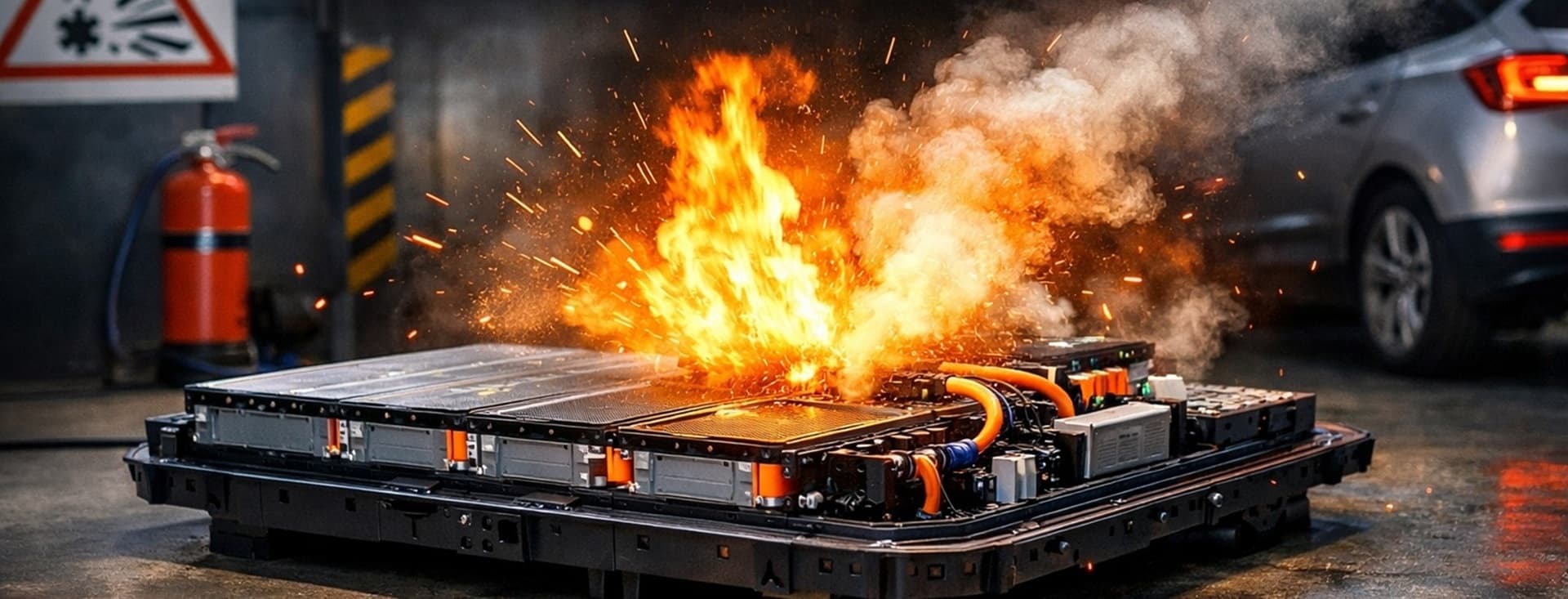
On March 28, 2025, China published GB 38031-2025 — "Safety Requirements for Power Batteries for Electric Vehicles" — replacing the previous GB 38031-2020. Industry analysts are calling it the strictest battery safety standard in history.
The headline rule: after a thermal runaway event, the battery system must produce no fire and no explosion for at least 120 minutes — a 24x increase from the previous 5-minute warning window. The standard takes effect on July 1, 2026.
What Changed from GB 38031-2020?
The 2020 version required a 5-minute early warning before any thermal event, giving occupants time to evacuate. The 2025 version eliminates that compromise entirely: fire and explosion are prohibited outright.
| Requirement | GB 38031-2020 | GB 38031-2025 |
|---|---|---|
| Thermal runaway containment | 5-minute warning before fire | No fire, no explosion for 120 min |
| Fire/explosion tolerance | Allowed after warning period | Zero tolerance |
| Smoke protection | Not specified | No smoke in passenger compartment |
| Early warning alarm | Required before thermal event | Within 5 min of thermal runaway onset |
| Bottom impact test | Not included | 30mm steel ball at 150J energy |
| Fast-charge safety test | Not included | Short-circuit test after 300 fast-charge cycles |

Key New Tests
GB 38031-2025 introduces 7 single-cell tests and 17 battery pack/system tests, including three entirely new categories:
- Bottom impact test: Simulates underside impacts from road debris using a 30mm steel ball at 150J energy. This directly targets cell-to-body (CTB) and cell-to-pack (CTP) architectures where the battery pack doubles as a structural floor element.
- Post-fast-charging safety test: After 300 consecutive fast-charge cycles (20% to 80% SOC, each within 15 minutes), the battery must pass an external short-circuit test with no fire or explosion. No other global standard tests this.
- Internal heating simulation: Tests for thermal events caused by internal heating sources, expanding beyond previous external-only assessment methods.
Additional requirements include salt spray testing and extended observation periods for delayed combustion — addressing latent risks that may not manifest immediately after an incident.
Implementation Timeline
| Date | Requirement |
|---|---|
| March 28, 2025 | Standard published |
| July 1, 2026 | New vehicle models must comply |
| July 1, 2027 | All existing models must comply |
Certification can only be issued by accredited bodies such as CATARC (China Automotive Technology and Research Center). Any component changes after initial certification require targeted retesting.
Who Is Affected?
Every EV manufacturer selling in China must comply — domestic and international. The impact varies significantly by battery chemistry:
- LFP (lithium iron phosphate) batteries — inherently more thermally stable. Chinese manufacturers like BYD (Blade Battery) and CATL are well-positioned. CATL was the first company to publicly confirm passing the new standard in April 2025.
- NMC (nickel-manganese-cobalt) batteries — higher energy density but less thermally stable. Japanese and South Korean suppliers (Samsung SDI, LG Energy Solution, Panasonic) face greater R&D investment to meet the zero-fire requirement.
Industry projections suggest 10-20% per-pack cost increases, which could accelerate consolidation among smaller battery suppliers.
How Does It Compare Globally?
| Region | Standard | Approach |
|---|---|---|
| China | GB 38031-2025 | No fire, no explosion for 120 min — strictest globally |
| EU | EU Battery Regulation / IEC 62660 | Safety + sustainability focus, no zero-tolerance fire mandate |
| US | FMVSS 305a (draft) | Crash safety and electrical isolation, less stringent on thermal runaway |
GB 38031-2025 significantly exceeds both EU and US requirements. Analysts note that China is setting safety benchmarks that competitors must follow, while its domestic manufacturers — dominant in LFP chemistry — are best positioned to comply.
What Should Businesses Do?
With the July 2026 deadline approaching, manufacturers should:
- Review battery pack designs against the new thermal propagation and bottom impact tests
- Validate fast-charging durability with the 300-cycle protocol
- Engage with CATARC or accredited certification bodies early
- Assess supply chain impact — smaller battery suppliers may not survive the cost increase
At ChinaStandards.org, we provide the full English translation of GB 38031-2025 for engineering teams and compliance professionals. Browse our catalog or contact us for specific requests.
Sources
- Gov.cn — China's new EV battery safety standard to take effect in July 2026
- CATL — First to meet GB 38031-2025 standard
- CARRAR — The New Chinese EV Safety Standard: A Strategic Power Play
- CarNewsChina — China mandates "No Fire, No Explosion" EV battery rule
- China-Certification.com — New battery certification standard GB 38031-2025