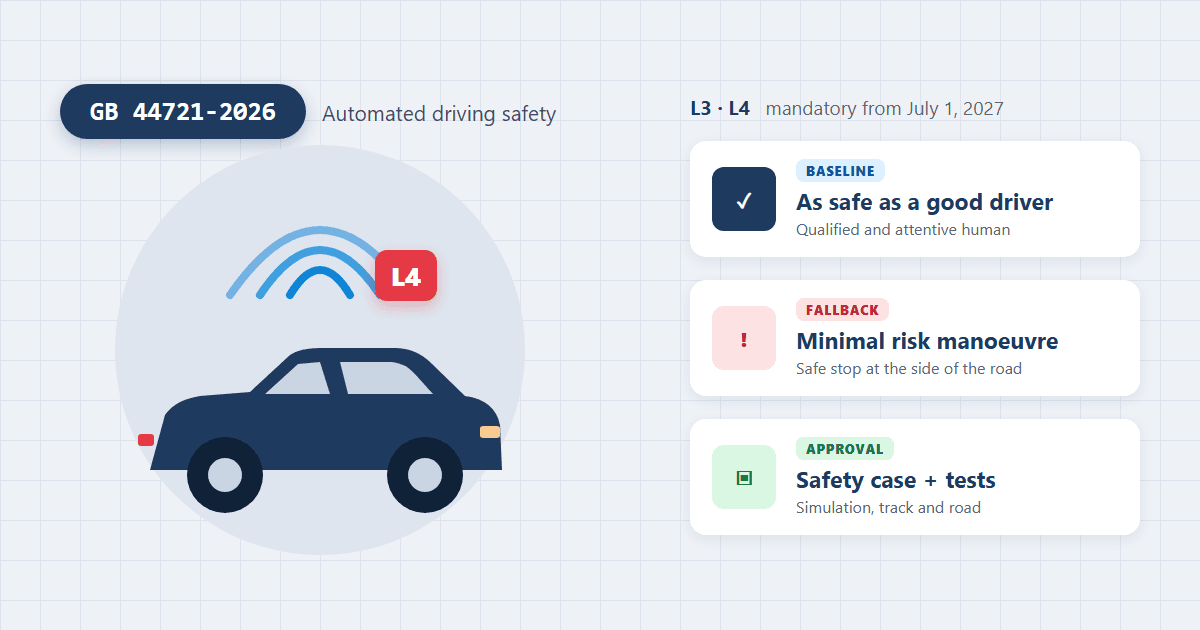
China now has a mandatory safety standard for automated driving. GB 44721-2026 sets what a level 3 or level 4 automated driving system (ADS) must do on the road, how it must hand over or stop safely, and how a regulator checks all of this before the vehicle is approved.
It was published on July 30, 2026 and applies from July 1, 2027. It replaces GB/T 44721-2024, which was a recommended standard: the "/T" is gone, and the rules become compulsory.
In short
- What it is
- China's mandatory safety standard for automated driving systems
- Chinese title
- 智能网联汽车 自动驾驶系统安全要求
- Applies to
- Passenger (M) and goods (N) vehicles with level 3 and/or level 4 driving automation — not automated parking
- Replaces
- GB/T 44721-2024 (recommended)
- Published
- July 30, 2026, by SAMR and SAC
- In force
- July 1, 2027
- Length
- 113 pages, with four normative appendices
Level 3 and level 4: what the standard expects
| Level 3 | Level 4 | |
|---|---|---|
| Who drives | The system performs the whole driving task within its operating conditions | The same |
| When something goes wrong | A fallback user must take over when asked; if they don't, the system makes a minimal risk manoeuvre | The system handles it by itself, with a minimal risk manoeuvre |
| Passengers | — | A passenger can ask the vehicle to stop, and it must stop safely |
| Specific rules | Appendix B (features on expressways and urban expressways) | Appendix C |
How the standard is organised
| Part | What it covers |
|---|---|
| Clause 5 | Technical requirements: driving in normal, critical and failure situations and outside the operating conditions, minimal risk manoeuvres, human-machine interaction |
| Clauses 6 and 7 | Safety assurance requirements, and how they are inspected |
| Clause 8 | Inspection of the manufacturer's safety case |
| Clause 9 | Confirmation tests |
| Clause 10 | When two vehicles count as the same type |
| Clause 11 | Implementation of the standard |
| Appendix A | Monitoring whether the driver is able to take over |
| Appendix B | Level 3 features on expressways and urban expressways |
| Appendix C | Level 4 features |
| Appendix D | The safety case |
What the system must do
The baseline: as safe as a good human driver
The first requirement sets the bar: the system must be at least as safe as a qualified and attentive driver performing the same driving task. It must not create unreasonable risks for users or other road users, it must recognise whether the current situation matches its operating conditions, and when active it performs the whole driving task.
Minimum capabilities
| Feature | Must at least be able to |
|---|---|
| Level 3, on roads other than expressways | Keep its lane, change lanes, go through intersections (roundabouts excluded) |
| Level 4, on expressways only | Keep its lane, change lanes, move partly or fully into the next lane to pass an obstacle |
| Level 4, on other roads too | All of the above, plus intersections, reversing and U-turns |
Driving in normal traffic
- Its own driving must not cause a collision, and it must not hit safety-related objects.
- It must anticipate risks, adapt its speed and keep a safe distance from other road users.
- It must have a strategy for areas it cannot see, such as spaces hidden by other vehicles.
- It must behave predictably and signal its intentions, with indicators and brake lights.
- It must follow the road traffic rules, without disrupting traffic flow unreasonably.
- Emergency vehicles: level 4 must give way; level 3 must give way or start its fallback response.
- Traffic police: level 4 must follow on-site instructions; level 3 must follow them or start its fallback response.
When things go wrong
- If a collision cannot be avoided, the system must reduce injury and damage.
- After a detected collision, it must bring the vehicle to a stop.
- It must detect faults that affect its driving. If it can no longer drive safely, it starts its fallback response and blocks other affected features; otherwise it reduces what it does to match the fault.
- Outside its operating conditions, a feature must not switch on — and if it is already on, it starts its fallback response.
Minimal risk manoeuvre
| Level 3 | Level 4 | |
|---|---|---|
| When | The fallback user has not taken over, or the safety case calls for it | The safety case calls for it |
| Target | A safe stop at the side of the road; if a severe failure makes that impossible, a safe stop in the current lane | A safe area out of traffic, at least the side of the road; in the current lane only after a severe vehicle failure |
| Both levels | Must be able to change lanes, keep risks to a minimum and use the hazard lights | |
| After the stop | The driver can always intervene; the system can only be switched on again after the vehicle is restarted | — |
Human-machine interaction
- The system must never switch on by itself when the vehicle is started.
- Safety messages must be noticeable, easy to understand and, where needed, given in more than one way (visual, sound, touch).
- During a fallback response, occupants must be told continuously what is happening.
- If the system controls the doors, the occupants' use of the doors comes first.
- After a detected collision, occupants must be informed.
How compliance is checked
A single test drive is not enough. GB 44721-2026 combines a review of the manufacturer's safety case (clause 8 and Appendix D), an inspection of the safety assurance requirements (clause 7) and confirmation tests (clause 9). It relies on five other Chinese standards:
| Standard | Topic |
|---|---|
| GB/T 47025 | Simulation tests for automated driving functions |
| GB/T 41798 | Track tests for automated driving functions |
| GB/T 44719 | Road tests for automated driving functions |
| GB/T 45312 | Operational design conditions for automated driving systems |
| GB 44497 | Data storage system for automated driving (mandatory) |
These references are undated, so the latest edition of each one applies. Simulation, track and road tests together form the test picture an approval relies on.
Timeline
| Date | What happens |
|---|---|
| 2024 | GB/T 44721-2024 published as a recommended standard |
| July 30, 2026 | GB 44721-2026 published by SAMR and SAC |
| July 1, 2027 | GB 44721-2026 applies and replaces GB/T 44721-2024 |
Clause 11 sets out how the standard is implemented, including for vehicle types already on the way to approval. Check it before you fix your programme dates.
Where it fits with GB 7258-2026
GB 7258-2026, China's new vehicle safety code, adds checks for driver assistance (level 2): activation checks, hands-off and eyes-off detection. GB 44721-2026 starts where driver assistance ends — at level 3 and level 4, where the system performs the whole driving task. Read our article on GB 7258-2026.
Who needs to act
- Car makers developing level 3 or level 4 features for China
- Robotaxi, robobus and automated truck developers and operators (M and N vehicles)
- ADS suppliers: perception, planning, human-machine interface, data recording
- Test laboratories for simulation, track and road testing
What to do now
- List your level 3 and level 4 features and their operating conditions for China.
- Check your minimum capabilities against the table above, feature by feature.
- Review your fallback and minimal risk manoeuvre logic for level 3 and level 4.
- Start the safety case early: Appendix D sets what it must contain.
- Plan simulation, track and road tests to the referenced standards.
- Check data recording against GB 44497.
The official text is published in Chinese only, and the details that matter for approval — scenarios, appendices, the safety case structure — are in the clauses themselves.
Get the full English version of GB 44721-2026 — 113 pages including all four appendices, invoice included. The data storage standard GB 44497-2024 and the test-method standards above are also available in English.