One of the most common questions from businesses entering the Chinese market is: what's the difference between GB and GB/T standards?
Understanding this distinction is critical for compliance, as it determines whether a standard is legally binding or merely a guideline.
The Chinese Standards Classification System
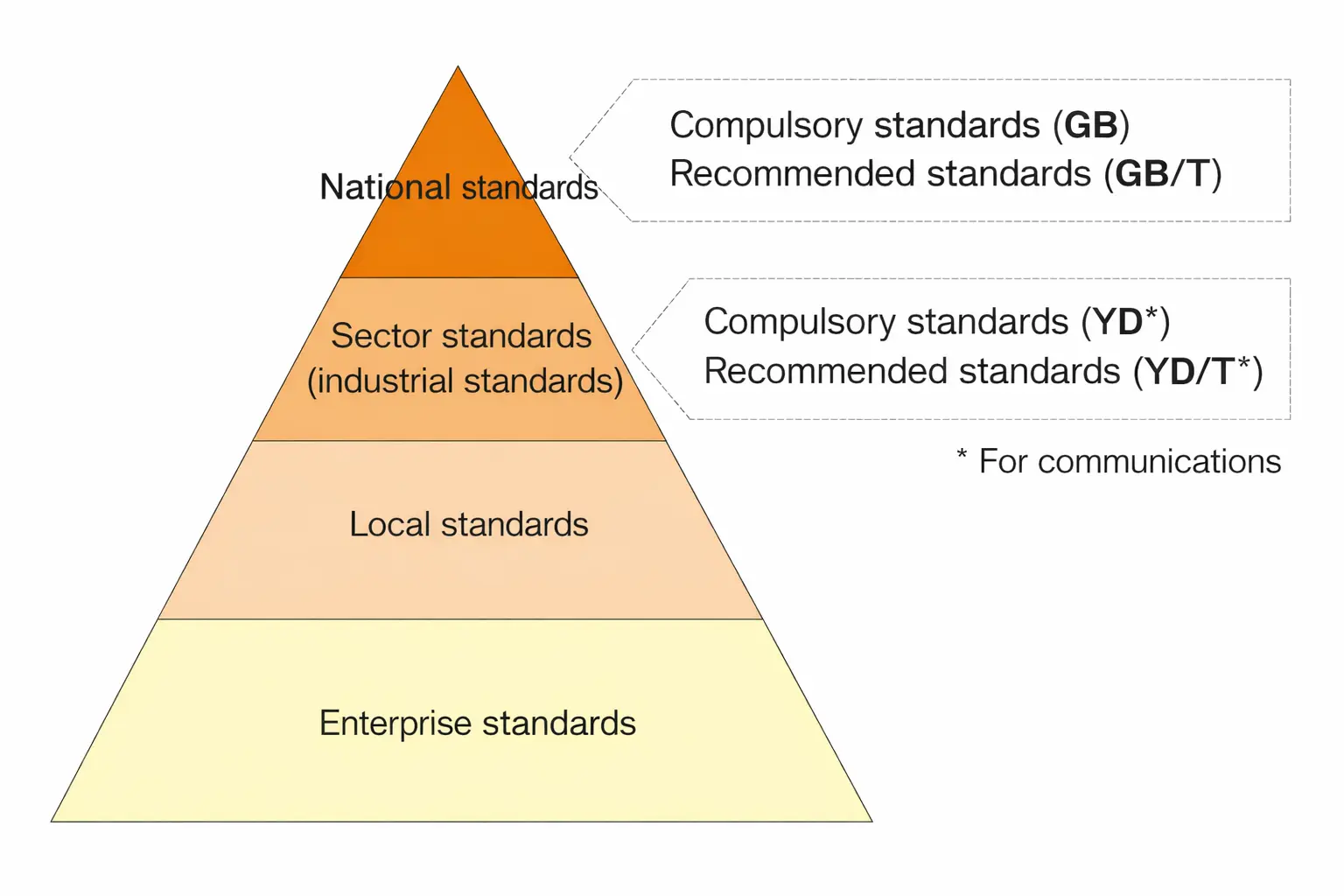
China's standardization system is governed by the Standardization Administration of China (SAC). Standards are classified into four levels:
- National standards (GB/GB/T) — Apply nationwide
- Industry standards (e.g., YY, JB, HG) — Apply to specific sectors
- Local standards (DB) — Apply to specific provinces or municipalities
- Enterprise standards (Q/) — Internal company standards
GB — Mandatory National Standards
Standards prefixed with GB (Guójiā Biāozhǔn, 国家标准) without the "/T" suffix are mandatory. Compliance is required by law. Products that fail to meet applicable GB standards cannot be legally sold in China.
Common examples include:
- GB 9685 — Food contact materials safety
- GB 38031 — EV battery safety requirements
- GB 4806 series — Food contact material standards
Enforcement is handled by market supervision authorities, and non-compliance can result in fines, product recalls, or import bans. The State Administration for Market Regulation (SAMR) oversees enforcement.
GB/T — Recommended National Standards
Standards prefixed with GB/T (where T stands for Tuījiàn, 推荐, meaning "recommended") are voluntary. Companies are encouraged but not legally required to follow them — with important exceptions.
A GB/T standard becomes effectively mandatory when:
- Referenced by a mandatory GB standard
- Specified in a government procurement contract
- Required by industry regulations or licensing
- Written into a commercial contract between parties
Industry Standards
Beyond national standards, China has over 80 industry-sector standard systems. Each uses its own prefix:
- YY — Medical devices
- JB — Machinery
- HG — Chemical industry
- TSG — Special equipment safety
- NB — Energy
- QB — Light industry
Industry standards can also be mandatory or recommended. For example, YY 0465 is mandatory for medical optical equipment, while YY/T standards are recommended.
How to Check Standard Status
Standards are regularly updated, superseded, or withdrawn. You can verify a standard's current status through:
- China's National Standard Information Public Service Platform
- Our standards catalog, which shows current validity status for every standard
Key Takeaways
- GB = mandatory, legally binding. Non-compliance = legal consequences.
- GB/T = recommended, but can become mandatory through references or contracts.
- Industry standards (YY, JB, etc.) follow the same mandatory/recommended pattern.
- Always verify the current status — standards get superseded regularly.
Explore our How It Works page for a visual overview of the Chinese standards hierarchy.