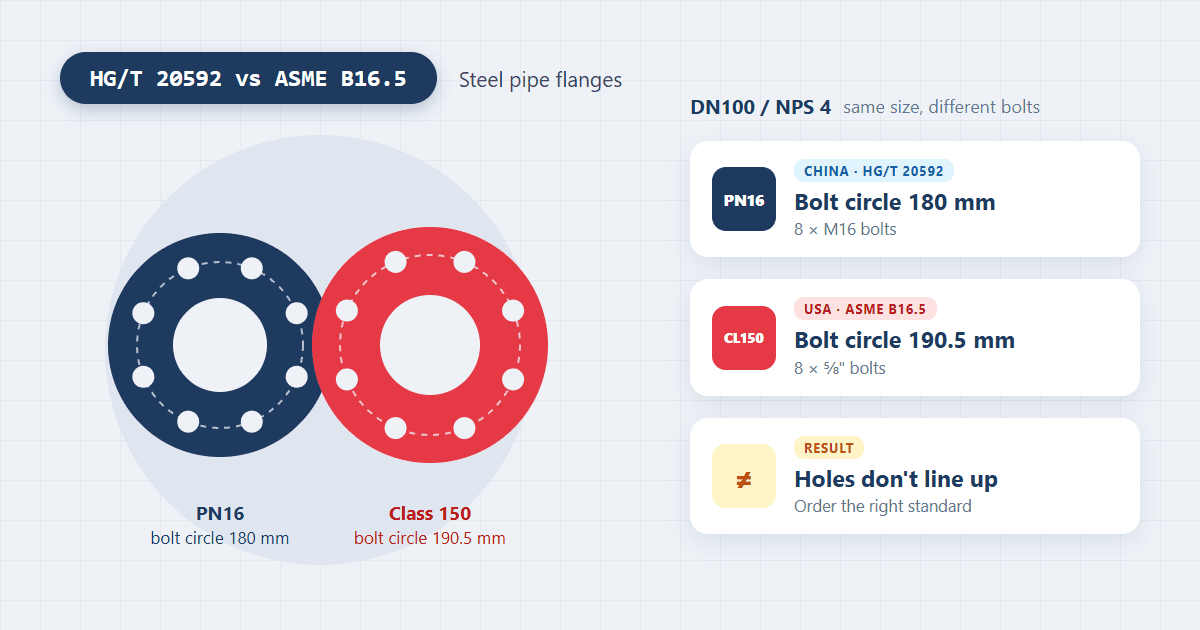
Here is a mistake that costs real money on project sites. The drawing says "4-inch, Class 150". The flanges arrive from China marked "DN100 PN16". Same pipe size, similar pressure, almost the same look. Then the fitter tries to put the bolts in, and they don't go through.
The reason is simple: they were made to two different systems. The Chinese flange follows HG/T 20592-2009, which uses PN pressure classes. The American one follows ASME B16.5, which uses Class ratings. This guide explains both, in plain words.
In short
- What it is
- China's chemical industry standard for steel pipe flanges, PN series
- Pressure classes
- 9 classes: PN2.5, 6, 10, 16, 25, 40, 63, 100, 160
- Sizes
- DN10 to DN2000, for two pipe series, A and B
- Issued by
- Ministry of Industry and Information Technology (MIIT)
- Dates
- Issued February 5, 2009 · in force July 1, 2009 (with a 2012 corrigendum)
- Key point
- A PN flange does not bolt to an ASME Class flange of the same size
What is HG/T 20592-2009?
It is the standard for steel pipe flanges and blind flanges used in China's chemical, petrochemical and process industries. HG is the code for the chemical industry; /T means it is a recommended standard. It replaced the 1997 series HG 20592 to HG 20605.
It covers sizes, pressure classes, materials, pressure-temperature ratings, flange types, sealing faces, tolerances and markings. It also applies to valves, pumps, chemical machinery and fittings that connect with flanges.
PN vs Class: two ways to rate a flange
| HG/T 20592-2009 | ASME B16.5 | |
|---|---|---|
| Pressure rating | PN (PN2.5 to PN160) | Class (150, 300, 400, 600, 900, 1500, 2500) |
| Size | DN in millimetres (DN10 to DN2000) | NPS in inches (½" to 24") |
| Same family as | The European PN system (EN 1092-1) | The American Class system |
| Chinese equivalent | — | HG/T 20615 (Class series) |
PN roughly tells you the pressure in bar the flange can hold at room temperature. Class is a rating number, not a pressure. They don't translate one to one: Class 150 is usually written as PN20, and Class 300 as PN50. Note that neither of those is in HG/T 20592's list. PN16 and PN40 are close in pressure, but they are different flanges.
The bolt holes don't line up: an example
Compare a 4-inch (DN100) weld neck flange in each system:
| HG/T 20592 · DN100 PN16 | ASME B16.5 · NPS 4 Class 150 | |
|---|---|---|
| Flange outside diameter | 220 mm | 228.6 mm (9") |
| Bolt circle diameter | 180 mm | 190.5 mm (7.5") |
| Number of bolts | 8 | 8 |
| Bolt hole | 18 mm, for M16 bolts | 19 mm (¾"), for ⅝" bolts |
Same number of bolts, almost the same hole size, but the bolt circles differ by 10.5 mm. The holes miss each other. No amount of force on site will fix that: the only real fix is the right flange.
Series A and Series B: the pipe matters too
HG/T 20592 has a second trap. It works with two different pipe sizes for the same DN:
| DN | Series A pipe OD | Series B pipe OD |
|---|---|---|
| DN50 | 60.3 mm | 57 mm |
| DN100 | 114.3 mm | 108 mm |
| DN150 | 168.3 mm | 159 mm |
| DN300 | 323.9 mm | 325 mm |
| DN500 | 508 mm | 530 mm |
- Series A is the international series. Its pipe outside diameters are the same as inch-based pipe: a DN100 Series A pipe is 114.3 mm, exactly like a 4-inch pipe.
- Series B is the older Chinese metric pipe series, still common in China.
So a Series A flange fits a 4-inch ASME pipe — but its bolt pattern is still PN. It will weld to your pipe and still not bolt to your ASME flange.
Flange types and sealing faces
HG/T 20592 uses short codes. You will see them on drawings and on the flange itself.
| Code | Flange type |
|---|---|
| PL | Plate flat welding flange |
| SO | Slip-on neck flange |
| WN | Weld neck flange |
| IF | Integral flange |
| SW | Socket welding flange |
| Th | Threaded flange |
| PJ/SE, PJ/PR | Loose (lap joint) flanges, with butt-welding or flat-welding ring |
| BL, BL(S) | Blind flange, lined blind flange |
Sealing faces: RF raised face, FF flat face, M / FM male and female, T / G tongue and groove, and RJ ring joint. Not every face exists for every type, size and PN: the standard has a table for that.
How to read a marking
Here is a real example from the standard:
HG/T 20592 flange WN100(B)-100 FM S=8mm 16Mn
- WN — weld neck flange
- 100(B) — DN100, for Series B pipe (Series A has no letter)
- -100 — PN100
- FM — female face
- S=8mm — pipe wall thickness
- 16Mn — material grade
The (B) is the detail to look for. If it is missing, the flange is for Series A pipe.
PN does not mean the same pressure at every temperature
The pressure a flange can really take depends on its material and temperature. The standard gives tables of the maximum allowed working pressure for each PN, material group and temperature. Two rules worth remembering:
- Below 20 °C, use the value for 20 °C.
- If two flanges in one joint have different ratings, the lower one sets the limit for the joint.
What should you do now?
- Check your drawings: PN or Class? Buy flanges from the matching standard. For Class flanges made in China, ask for HG/T 20615, not HG/T 20592.
- Check the pipe series: Series A or B? Look for the (B) in the marking.
- Order with all the data the standard asks for: standard number, flange type, face, DN, PN, wall thickness (for weld neck), material.
- Check the pressure-temperature table for your material at your operating temperature.
- Match gaskets and bolts to the same system — the HG/T 20606 to HG/T 20614 series covers them.
The full standard has all the dimension tables, by type and PN, plus materials, welding details and tolerances — about 150 pages.
Get the full English PDF of HG/T 20592-2009 now — instant download, invoice included. Need HG/T 20615 or another flange standard? Ask us.